In the quiet, ancient villages of the Sinjar mountains, childhood was once defined by an oral tradition dating back millennia. That peace was shattered on August 3, 2014, when the Islamic State launched a genocidal assault on the Yazidi people. As an author, I have spent much of my recent work attempting to capture the magnitude of this fracture; as an educator, I see the living, breathing reality of that fracture every day in my classroom.
The children who survived this “lost generation” endured horrors that defy comprehension—boys ripped from families for indoctrination, girls trafficked into slavery. When they finally found sanctuary, their path led them here, to my home in Toowoomba, Australia.
The Classroom as a Crucible
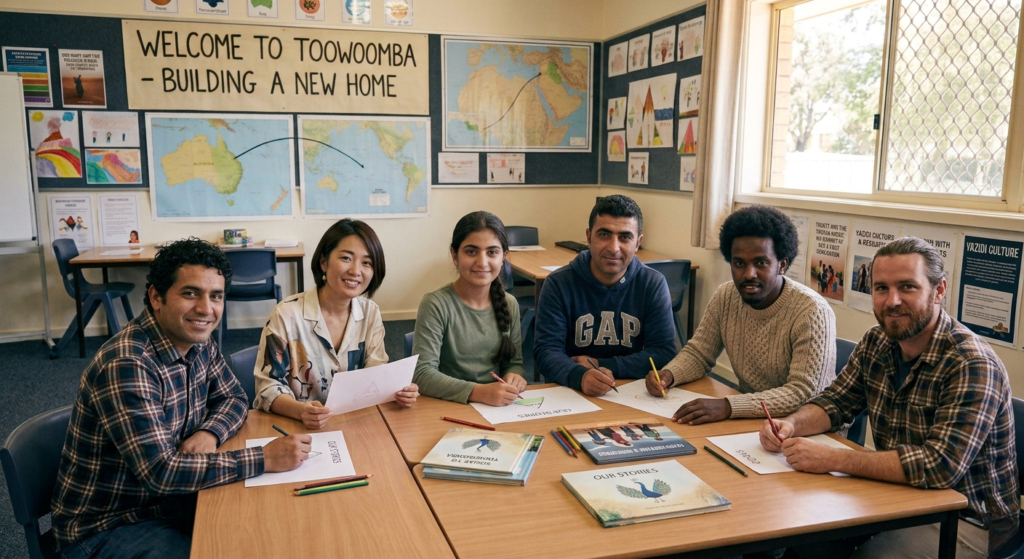
In my work as an English teacher, I am often the first point of contact for these youth as they navigate a new language and a foreign culture. They arrive in our schools categorized as “Students with Interrupted Formal Education” (SIFE), but this clinical term fails to capture the complexity of the human before me.
I see the resilience required to transition from the trauma of the Sinjar mountains to the quiet streets of regional Queensland. In my lessons, I witness the “thwarted belongingness” that experts describe, manifested as a quiet struggle to reconcile the identity they were forced to abandon with the English-speaking world they are now expected to embrace. Some students arrive illiterate in their mother tongue, and many carry a visceral, justifiable refusal to speak Arabic—the language of their former captors. Helping them find their voice in English, while respecting the silence they sometimes need to protect their past, is the most delicate work I do.
Weaving Truth into Fiction
This intersection of duty and discovery has become the heartbeat of my writing project: a three-part series centered on the historical and cultural experiences of displaced communities from the Middle East.
When I sit down to draft these stories, I am not merely writing fiction; I am synthesizing the patterns I observe in our local community. I see the intergenerational conflict—the clash between parents desperately clutching at ancient, endogamous traditions to preserve their history, and youth who, through the lens of Australian critical thinking, are pushing for the autonomy to heal and define themselves.
My characters, much like my students, are caught between two worlds. Through my writing, I aim to provide a scaffold for their experiences, transforming the “red dust” of their journey into a narrative that bridges the gap between their displacement and their eventual flourishing.
A Community in Transition
In Toowoomba, I witness the moments where the weight of history gives way to the levity of the present—the bewilderment at a swooping magpie, the marvel at the abundance in our supermarkets, or the camaraderie at a local picnic. These are the moments I store away for my books, the small, human truths that illustrate how these families are building a “chosen community.”
As an educator, I am reminded daily that my students are not just survivors of a genocide that sought to erase them; they are the architects of their own future. As an author, I feel the profound responsibility to ensure their stories are told with the dignity and nuance they deserve. By bridging the deep, sacred traditions of the Sinjar mountains with the freedoms of their new Australian home, they are proving that even after the darkest of nights, a new life can take root and flourish.