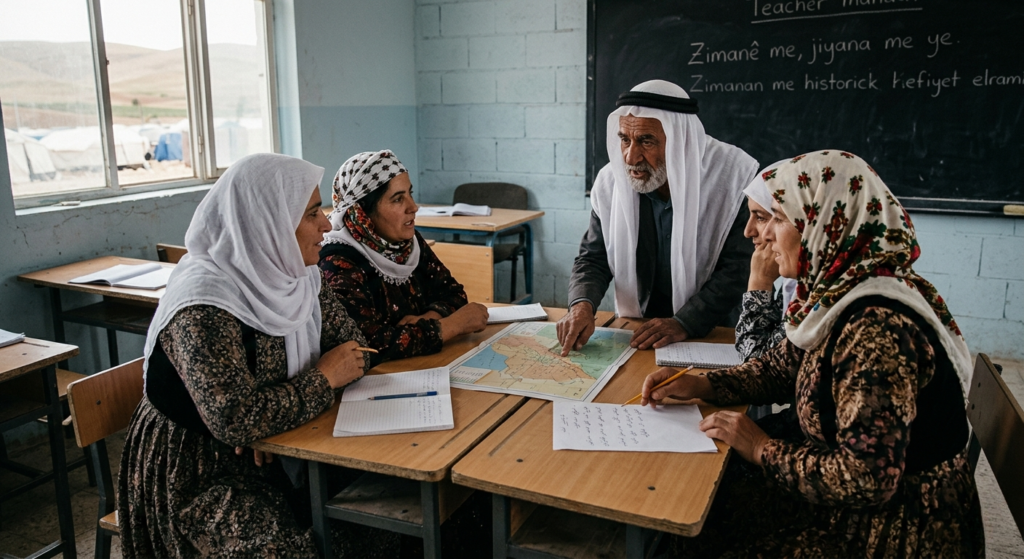
For those of us working in education and advocating for displaced populations, the classroom—or the writing desk—is never neutral territory. When teaching Yazidi students, we are working with individuals whose primary language, Kurmanji, has become an act of defiance against a history of erasure. Understanding why many Yazidis harbor a deep aversion to the Arabic language is essential for any educator or writer seeking to approach this community with the sensitivity and gravity their experience demands.
The Classroom as a Space of Linguistic Trauma
In my work focusing on the loss of education, it is vital to recognize that for many Yazidi students, the formal education system was not a neutral vehicle for knowledge; it was an instrument of state-sponsored assimilation.
During the Ba’athist regime’s “Arabization” campaigns, education was weaponized. Yazidi children were forced into classrooms where their mother tongue was banned, their history erased, and their identity systematically rewritten. When I document the “loss of education” among the Yazidi, I am not just talking about missed school years; I am talking about the systemic theft of their indigenous cognitive space.
For those who survived the 2014 genocide, the trauma is compounded. Because the captors spoke Arabic, the language is often not a tool of communication, but a physiological trigger for PTSD. In a learning environment, this creates a unique challenge: if I rely on Arabic-language materials, I may inadvertently mirror the dynamics of their displacement, inadvertently re-traumatizing those I am trying to empower.
Language as an Act of Resistance
My writings on displacement highlight the physical loss of the Sinjar homeland. Yet, the loss of land is mirrored by the threat of linguistic displacement.
- The Sacred Orality: Unlike the state-mandated Arabic of the classroom, Kurmanji is the vessel of the qawls—the sacred, oral hymns that define the Yazidi faith. For my students, preserving Kurmanji is an act of preserving their divine lineage.
- The Protective Shield: I have observed that for some, Arabic is used as a “protective disguise” in public, hostile environments to avoid targeting. This duality—using a language for survival while fearing it for its association with oppression—is a core tension in the displaced Yazidi identity that I aim to capture.
Implications for Educators and Writers
As I continue my vital work, the relationship between the Yazidi people and language serves as a crucial reminder of two things:
- Educational Autonomy is Identity: When I advocate for the right to education for displaced Yazidis, I must prioritize curricula that honor their linguistic roots. Forcing a student to learn through the language of their oppressor is a continuation of the displacement I document in my writing.
- Trauma-Informed Communication: My research into loss and displacement is underscored by the reality that language is never “just” a medium. Whether I am facilitating a lesson or drafting a narrative, recognizing that Arabic may evoke the violence of 2014—and the historical brutality of the Ba’athist era—is essential for fostering the trust required for true academic and personal growth.
A Final Reflection
In my teaching, every Kurmanji word spoken by a student is a reclamation of the identity that was targeted for extinction. By centering this linguistic reality in my writing and my pedagogy, I am doing more than documenting displacement; I am providing a platform for a culture that has historically been forced into silence. I am helping them transform the language of survival into a language of continuity.