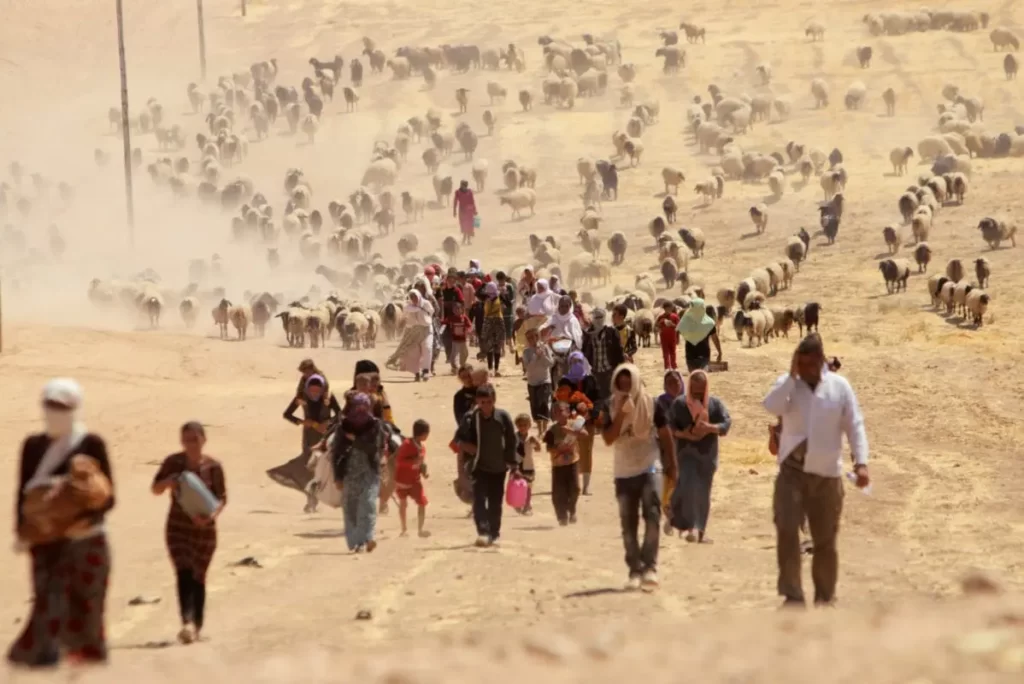
On 2 August 2014, the sun set over the ancestral homeland of the Yazidi people in the Sinjar district of northern Iraq. It was a vibrant day of celebration—a religious holiday marking the end of a solemn fasting period. Under a blistering summer sun peaking above 40°C, families slaughtered sheep, shared sweet treats, exchanged local news, and gathered with loved ones in the shadow of Mount Sinjar. Yet, as twilight fell, unfamiliar headlights flickered across the dusty desert horizon. Whispers of dread filled the evening air. By the dawn of 3 August 2014, those flickering lights manifested as the armed convoys of the Islamic State of Iraq and the Levant (ISIS), launching a swift, merciless, and systematic assault designed to eradicate the ancient Yazidi ethno-religious community from the face of the Earth.
In the span of mere hours, an idyllic holiday turned into an unutterable nightmare. Approximately 400,000 Yazidis were executed, abducted, or forcibly displaced from their ancestral villages. The onslaught was carried out with chilling, bureaucratic precision. ISIS fighters rounded up entire communities, forcing men and older boys to choose between immediate conversion to Islam or execution. Over 5,000 men were slaughtered, their bodies dumped into more than 90 mass graves scattered across the Nineveh plains. In the village of Solagh, 111 elderly women were separated from their families and shot dead or buried alive in what became mournfully known as the “Grave of the Mothers”.
Meanwhile, more than 6,400 women and young children were kidnapped. Women and young girls—some barely past primary school age—were dragged away, bound in chains, and transported to slave markets across Iraq and Syria. They were bought and sold on encrypted digital applications, subjected to relentless gang rape, physical torture, and systematic psychological humiliation. Young boys were torn from their grieving mothers’ arms to be brainwashed in military camps and converted into child soldiers. Seeking escape from this apocalyptic violence, up to 200,000 desperate civilians fled to the barren, unforgiving cliffs of Mount Sinjar. Trapped on the mountain without food, shelter, or water in scorching heat, hundreds of infants, children, and elderly people perished from sheer thirst and exhaustion.
For the Yazidi people, August 3rd is not merely a date on a calendar; it is a profound wound etched into the collective soul of an entire nation. Commemorated annually as Roja Reş—the “Black Day”—and recognised as the 74th Firman (genocidal decree) in their long history of persecution, August 3rd represents the tragic apex of their historic struggle for survival. Understanding why and how the Yazidi community commemorates this black day reveals the unbearable sadness of their past, the emotional weight of their present, and the indestructible spirit of their future.
The Meanings of Commemoration: Resistance Against Erasure
Why do Yazidis across the globe gather every August 3rd to commemorate this horrific invasion? First and foremost, commemoration is a sacred duty of memory—a solemn vow to honour the dead, to mourn the thousands whose lives were brutally stolen, and to keep vigil for those who remain missing. More than a decade after the genocidal campaign began, over 2,500 Yazidi women and children remain missing, trapped in lingering captivity or lost in unidentified mass graves. For families who never received the closure of burying their loved ones, the annual commemoration offers a physical space and a unified voice to scream their grief to an international community that too often looks away.
Furthermore, commemoration is an active demand for justice and accountability. It serves as a stark protest against impunity, insisting that the perpetrators of these monstrous acts be prosecuted for genocide and crimes against humanity. In an oral culture where history, faith, and identity are preserved through song, recitation, and storytelling, public remembrance is essential to passing down the truth of what happened to future generations.
Crucially, commemorating August 3rd is an act of defiance. ISIS openly declared its intention to permanently destroy the Yazidi faith, language, and culture. By gathering publicly each year in Sinjar, Australia, Germany, Georgia, and across the world, the Yazidis declare that the terrorists failed. To commemorate is to say: We survived, our identity remains intact, and we refuse to be erased.
Anatomy of a Commemoration Event: Rituals of Memory and Shared Pain
Yazidi commemoration events are deeply moving, highly structured, and intensely emotional gatherings designed to honour the fallen while supporting the living. While ceremonies occur globally—from the dust of Sinjar to community halls in Toowoomba, Wagga Wagga, and Sydney in Australia—they share unified, culturally sacred elements.
A standard commemoration event involves several key components:
- The Moment of Silence: At exactly 10:00 am, a nationwide and global minute of silence is observed. Traffic stops, crowds stand motionless, and a heavy, reverent quiet settles over the gathering to honour the victims of the initial massacres.
- Gathering at Sacred Sites and Memorials: In Sinjar, thousands assemble at the Yazidi Genocide Memorial in Solagh, built near the Grave of the Mothers. In the diaspora, communities gather at public centres, churches, or cultural hubs.
- Visual Documentation and Photographic Memorials: In ruined towns like Sinjar City, families drape photographs of missing and murdered relatives over shattered concrete rubble. At international events, photo exhibitions display raw, heartbreaking images of mass graves, destroyed shrines, and letters written by survivors.
- Oral Histories, Poems, and Mourning Songs: Consistent with Yazidi oral tradition, survivors take the stage to share raw, unvarnished testimonies. Traditional Yazidi mourning songs (stran) and poems are recited, giving voice to the unbearable agony of lost mothers, stolen daughters, and executed brothers.
- Symbolic Rituals of Remembrance: Participants engage in symbolic acts of healing, such as lighting candles, planting trees of peace, displaying folk art, or creating joint artistic murals centred on human rights and dignity.
- A Sanctuary for Grief: Commemorations are intentionally designed to allow community members to openly weep, embrace, and express their overwhelming sorrow. Because graphic imagery and harrowing testimonies can be deeply triggering for young minds, children are often encouraged to participate in gentler, supportive educational activities rather than exposure to distressing media.
The Crushing Weight of Memory: Emotional Impact and the “Anniversary Effect”
The emotional impact of these commemorations cannot be overstated. The sadness surrounding August 3rd is not a distant historical grief; it is a raw, bleeding wound. Psychological studies and community support organisations like STARTTS in Australia note that as August approaches, Yazidi survivors experience a profound “anniversary effect”.
In the weeks leading up to the commemoration, survivors suffer from elevated psychological distress, severe anxiety, sleep deprivation, nightmares, hypervigilance, and intrusive flashbacks of the day they were torn from their homes. During commemoration events, the sheer weight of memory frequently causes intense physical reactions. It is common for women to weep uncontrollably, faint, or experience emotional collapse as the horrific sounds of gunfire and the screams of stolen children echo in their minds. As survivor Shiren Ibrahim Ahmed recounted while standing near the mass grave where her mother was killed: “During war, men are usually killed. What made me suffer the most of the whole genocide is the killing of our mothers. We didn’t deserve that”.
This sorrow is compounded by the harsh reality that for most Yazidis, the trauma has never ended. Over 190,000 Yazidis still languish in bleak internally displaced persons (IDP) camps in Kurdistan, living in worn canvas tents under extreme weather conditions, unable to return to a Sinjar that remains ungoverned, unexploded-bomb-ridden, and largely in ruins. More than 80 mass graves have been discovered, but only a fraction of the bodies have been exhumed, identified via DNA, and returned to families for a dignified burial. Families continue to endure the agonizing torture of waiting every single day, wondering if their missing daughters or sisters are still alive in captivity.
An Unbroken Spirit: Resurgence and the Light of Yazidi Resilience
Yet, if the story of August 3rd begins in the deepest valleys of human cruelty and sadness, it finishes on the highest peaks of human courage. The ultimate message of the Yazidi commemoration is not one of defeat, but of extraordinary, indomitable resilience.
Throughout their history, the Yazidi people have endured 74 separate genocidal campaigns, yet their faith, culture, and spirit have never been broken. In the aftermath of the 2014 invasion, when the world stood by, Yazidi survivors transformed their unspeakable trauma into a global crusade for justice. Courageous Yazidi women who survived the horrors of ISIS captivity—such as Nobel Peace Prize Laureate Nadia Murad and activist Farida Khalaf—stepped onto the world stage. They looked world leaders, judges, and foreign ministers in the eye, recounting their pain to demand international legal accountability, the rescue of missing captives, and the reconstruction of their homeland.
On the ground in Sinjar, despite immense political neglect, the community has begun the arduous process of rebuilding amid the ruins. Sacred pilgrimage sites like the Mam Rashan Shrine have been restored stone by stone, standing as gleaming beacons of spiritual renewal against the sky. The enactment of Iraq’s Yazidi Survivors Law represents a groundbreaking, survivor-led legislative victory that provides reparations, land, and educational support to those who survived captivity.
In host nations like Australia—which has warmly welcomed thousands of Yazidis seeking asylum—the community is not merely surviving; it is beginning to flourish. Supported by dedicated organisations, Yazidi families are healing, educating their children, establishing youth associations, and contributing their rich culture and wisdom to the multicultural tapestry of their new home.
When Yazidis gather every August 3rd to light candles, sing traditional songs, and shed tears for what was lost, they are keeping an eternal flame alive. The sadness of Roja Reş is profound, but the light of Yazidi resilience shines far brighter. They commemorate August 3rd so the world will never forget—and so that future generations will know that even in the face of absolute darkness, humanity, dignity, and love will always prevail.