The 2014 genocide perpetrated by the Islamic State (ISIS) against the Yazidi people in the Sinjar region of northern Iraq led to the violent displacement of hundreds of thousands of people, systemic sexual enslavement, and the tragic loss of countless lives. In response to this catastrophic humanitarian crisis, Australia opened its doors, specifically focusing its Humanitarian Program on resettling Yazidi women, children, and families who had survived these almost unimaginable horrors. Between 2016 and 2021, the Yazidi population in Australia grew exponentially from just 63 individuals to over 4,100, making it the fastest-growing religion in the country. Escaping severe trauma, these refugees have sought to rebuild their lives in a new hemisphere. In my own writing on refugee displacement, I often explore this fragile transition—the liminal space between the loss of a homeland and the slow, painful process of grounding oneself in unfamiliar soil. Today, that text comes alive in my daily work. As an educator teaching both adult and youth Yazidi students right here in Toowoomba, I witness firsthand how these survivors navigate significant settlement challenges, including systemic healthcare barriers, language acquisition, and the enduring psychological toll of genocide, while fiercely preserving their ancient culture.
Settling in Regional Towns and Building Networks
Rather than clustering in major metropolitan centres, the Yazidi diaspora in Australia has predominantly been settled in regional cities. While communities have taken root in places like Armidale, Wagga Wagga, Coffs Harbour, and Mount Gambier, Toowoomba has become one of the primary sanctuaries for this displacement narrative. These regional towns were strategically selected because they offer affordable housing, strong community kinship, and agricultural environments that align closely with the Yazidis’ traditional farming backgrounds in the Sinjar plains.
To navigate this entirely new environment, my students and their families rely on robust support networks. Organisations such as Settlement Services International (SSI), CatholicCare, and the Yazidi Australian Association (YAA) play a pivotal role in their integration. The YAA, an independent, volunteer-led non-profit, provides bilingual caseworkers who assist newly arrived families with securing private rental housing, opening bank accounts, navigating government systems like Medicare and Centrelink, and enrolling children in schools. In Toowoomba, a “whole-of-community” approach has fostered deep connections between the Yazidi diaspora and local residents. From community-supported agricultural initiatives that allow them to utilise their farming skills, to local sporting clubs where over 50 Yazidi men and several female youth have joined regional soccer teams, these spaces help my students forge informal networks, build friendships, and reclaim a sense of agency.
Keeping Culture and Identity Alive
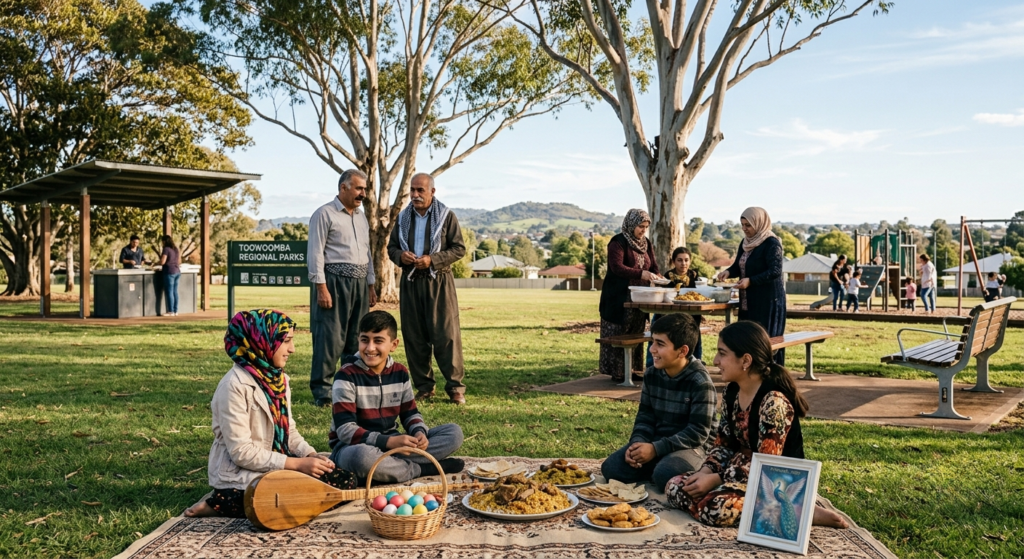
Despite the massive weight of their displacement—a central theme in my writings—the Yazidis in Toowoomba are deeply committed to keeping their ancient heritage, faith, and the Kurmanji language alive. Yazidism is an ancient, non-missionary monotheistic faith rooted in oral traditions and hymns (Qawls) rather than holy books, centering around a supreme creator and seven holy angels led by Melek Taus, the Peacock Angel. Acknowledging that they have survived 74 historical genocides, or Fermans, the diaspora actively organises classes for the Kurmanji language, traditional music featuring the Tembûr, and folk dancing to ensure that second-generation immigrants maintain a proud cultural identity.
Cultural festivals and sacred holidays serve as major touchstones for the community, vibrating through the local landscape. The Yazidi New Year, known as Charshema Sor or Ser Sal, is celebrated vibrantly across Toowoomba on the first Wednesday of April. These celebrations feature live music, traditional circle dancing, and the symbolic colouring and breaking of boiled eggs to represent the earth and life. Food acts as a powerful bridge between cultures, with traditional dishes like biryani and stuffed vine leaves introducing their unique cuisine to the broader Australian public. The community has also worked closely with local councils to establish dedicated, culturally appropriate burial sites featuring traditional dry-stone walls—a crucial step in allowing them to feel permanently rooted, safe, and at peace in their new home.
The Challenges of Settling in Regional Australia
However, the transition to life in regional Australia is fraught with complexities that I see reflected in the eyes of my students every day. Healthcare access and health literacy remain critical challenges. In our Toowoomba Yazidi community, mental health struggles, diabetes, and high blood pressure are incredibly common. My students face significant barriers navigating the Australian medical system, compounded by long wait times for bulk-billing general practitioners and difficulties accessing appropriate Kurmanji interpreters. Moreover, Australian medical practices can be culturally jarring. The legal requirement of “informed consent”—where doctors detail all procedural risks—often terrifies Yazidi patients who expect doctors to act as unquestioned authorities, sometimes leading them to refuse necessary medical procedures out of fear. Discussions around life expectancy and preparations for death are similarly confronting.
Language acquisition and employment form another major hurdle, and this is where my role as their teacher becomes central to their journey. Having been a persecuted minority with limited access to formal education in Iraq and Syria, many of my adult students arrived with low literacy levels in their first language. This significantly impacts their progress in learning English through programs like the Adult Migrant English Program (AMEP), which in turn limits their pathways to vocational training and sustainable employment. While Intensive English Centres in local high schools have thrown a lifeline to the youth, adults struggle to navigate jobactive employment providers. In the classroom, I must balance teaching basic literacy with an acute awareness of the cognitive load that trauma places on memory and learning.
Above all, the psychological scars of the genocide loom large over our lessons. Many of my students, both youth and adults, are consumed by grief for family members who were killed or remain missing or enslaved in the Middle East. The deep desire for family reunification is a persistent source of anxiety; many attempts to bring relatives to Australia have failed, and those left behind languish in freezing displacement camps without a homeland to return to. While the Yazidi community attempts to send remittances back to Iraq to support struggling relatives, they face logistical barriers due to banking constraints, often relying on informal Hawala networks to transfer small sums of money.
Furthermore, hard-won feelings of safety in Australia have occasionally been shattered. The recent repatriation of Australian women and children linked to the Islamic State from Syrian camps caused severe distress among the Yazidi community across regional Australia. For survivors in our community who suffered unimaginable abuse at the hands of ISIS, the arrival of IS-linked individuals triggered intense trauma, leading to hospitalisations, an increased need for psychological counselling, and a profound fear that they are no longer truly safe. Most of my students have no intention of permanently returning to Iraq due to the lack of justice, ongoing insecurity, and destroyed infrastructure, choosing instead to focus their hopes entirely on Australia.
Conclusion
The resettlement of Yazidi refugees in Toowoomba is a powerful, living testament to human resilience. Having survived systemic genocide and the destruction of their homeland, they have transformed our regional city into a sanctuary where their ancient faith, language, and traditions can be safely preserved. Through grassroots networks, agricultural initiatives, and the shared space of our classroom, they are actively contributing to Australia’s multicultural fabric.
Yet, as I document in my writings on displacement, their journey of healing is far from over. Overcoming language barriers, bridging cultural gaps in healthcare, and managing profound trauma require ongoing, specialized support. As an educator, I see that our responsibilities extend far beyond the whiteboard. Ensuring pathways for family reunification and fostering an environment of absolute safety remain essential for the Yazidi diaspora—and my students—to fully thrive in their new home.