June 3rd, 2002 – Taipei, Taiwan
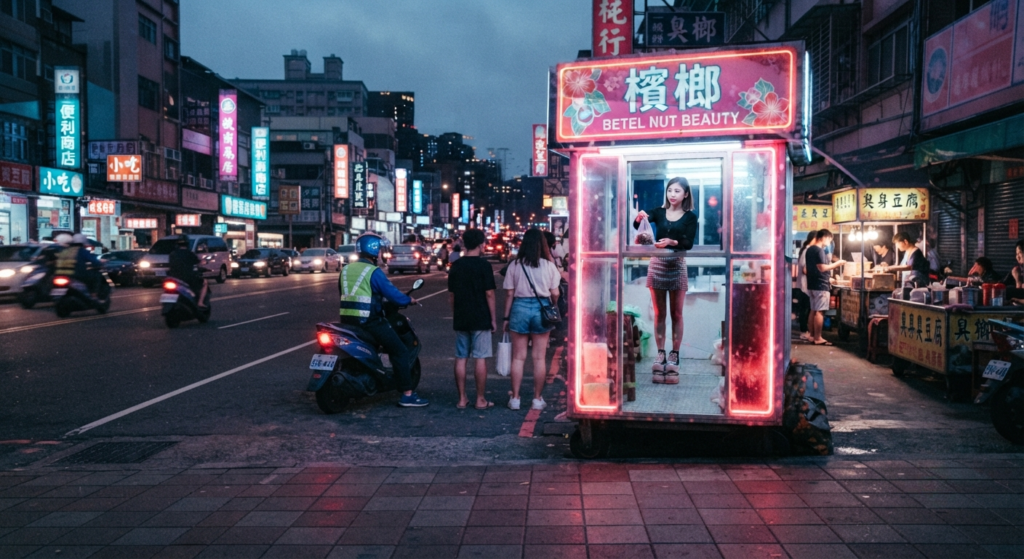
I am twenty-eight, single, and currently vibrating at a frequency usually reserved for tuning forks and panicked chihuahuas. I’m in the back of a taxi, hurtling down a dark suburban highway, when the night is violently interrupted by what looks like a UFO landing. It’s a glowing, neon-lit glass kiosk parked right on the shoulder of the road. And inside this brightly lit box sits an absolute vision of a woman.
She is dressed in a tiny, checkered mini-skirt, a bra, and six-inch platform shoes. Let’s be brutally honest: as a single guy navigating a foreign country, this is exactly the kind of roadside attraction that makes you want to face-plant into the passenger window. I frantically ask my driver, Mr. Chen, what kind of open-air cabaret we’ve just stumbled upon. Are we in a red-light district? No, he chuckles, exposing a terrifying set of red-stained teeth. These are the bīnláng xīshī—the Betel Nut Beauties—a name that pays homage to Xi Shi, one of the legendary beauties of imperial China.
We pull over, and the girl dashes to my window. I try to act suave, but I’m hopelessly out of my depth. While sociologists debate whether these women are victims of patriarchal exploitation
or empowered entrepreneurs utilizing their own bodily autonomy, I am mostly just trying to remember how to form a complete sentence. She is stunning, yet her demeanor is surprisingly prim, all-business, and entirely immune to my awkward, jet-lagged staring. I hand over a 50 New Taiwan Dollar coin (about a buck sixty-five). She gives me a polite smile, hands me a small plastic bag, and retreats to her neon fortress to wait for the next lovestruck trucker.
Inside the bag are several small, green, olive-looking things wrapped in leaves. Mr. Chen explains that the “betel nut” is actually the seed of the Areca catechu palm tree—so it’s a fruit, not a nut. It’s wrapped in a betel leaf for a peppery kick and smeared with a white slaked lime paste made from seashells. This paste is the magic ingredient; it triggers a chemical reaction that unlocks the nut’s psychoactive alkaloids.
“Eat,” Mr. Chen commands, gesturing wildly.
I pop one in and bite down. A sharp, spicy pepper flavor floods my tastebuds. But then, thechemical reaction kicks in. My mouth turns into a localized disaster zone. The juices mix with the lime, and suddenly I am producing an alarming amount of blood-red saliva. I look like a vampire who forgot his table manners. Mr. Chen hands me a plastic cup, and I spit the crimson liquid out, officially joining the ranks of what the Taiwanese playfully call the “red-lip clan.”
Then, the rush hits—a freight train of caffeine. Chewing one of these is like chugging three cups of espresso back-to-back. A warm, electric tingling starts in my gums, numbing my lips, and spreads through my shoulders and chest. The world slows down, but my heart is doing a frantic samba. I completely understand why long-haul truckers and night-shift workers use this as their go-to stimulant. It’s essentially an all-natural, highly accessible cigarette that grows on a tree.
Mr. Chen regales me with the history of the industry, which hit its peak in the 90s when competition forced vendors to turn to neon lights and bikini-clad staff to ensure guys like me told their taxi drivers to pull over. He mourns the “three nos” policies of the 2000s, which forced cities to crack down on the more revealing attire. As an admirer of the female form, I silently protest this historical tragedy, though I suppose the distracted drivers crashing into highway medians didn’t help the cause.
Five minutes in, I decide to be brave and pop a second one. Big mistake. The initial buzz is abruptly tackled by a wave of nausea. My jaw moves on autopilot, squeezing out more arecoline, and my legs feel like they weigh two hundred pounds each, sinking deep into the taxi’s synthetic leather.
Mr. Chen is talking to me, but I am too far gone to respond. I’m sweating, staring out the window at the passing neon blur. Every few miles, another glass box appears. More flashing lights, another stunning girl, another flash of skin. It’s a hypnotic, surreal rhythm—a slice of life that perfectly explains why this bizarre grassroots culture has been the subject of award-winning art films. The juxtaposition of blue-collar grit and neon-drenched glamour is, if nothing else, undeniably cinematic.
I later learn the government is cracking down, citing that the preparation of this “Taiwanese chewing gum” is highly carcinogenic. Between the health warnings and the dress code enforcements, the era of the Betel Nut Beauty is slowly fading.
As I stumble out of the taxi at my hotel, my teeth stained a terrifying shade of crimson and my brain buzzing with tropical alkaloids, I look back at the dark road. I might have permanently stained my gums, but getting buzzed off a palm tree fruit sold by a gorgeous girl in a neon glass box is the exact kind of brilliant, weird, and wonderfully unique experience you can only find in Taiwan.