Taipei – 2003
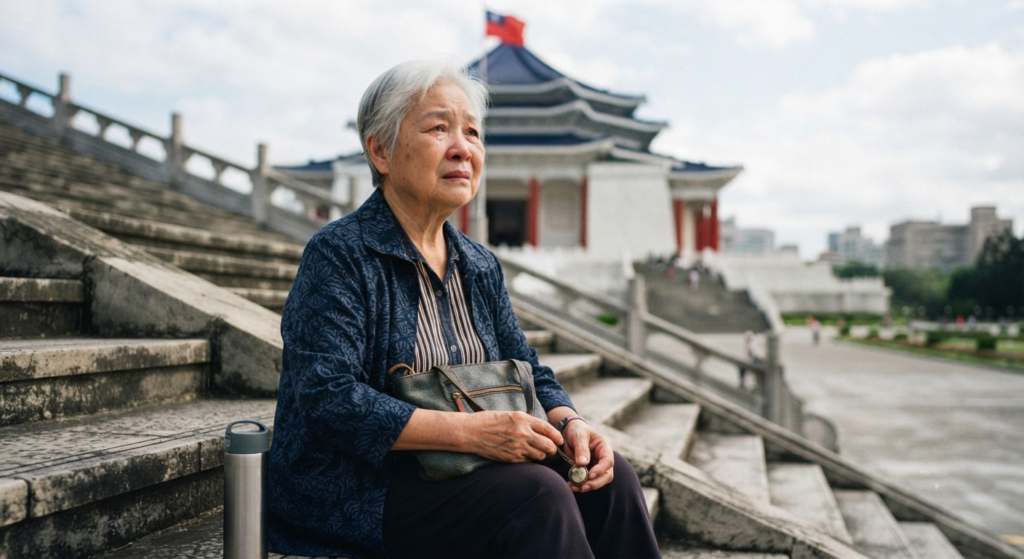
The morning light in Taipei did not merely dawn; it bruised the horizon, a slow, humid violet that eventually surrendered to the heavy, golden haze of a Sunday. I found myself sitting on the weathered stone steps of the Chiang Kai-Shek Memorial Hall, a spectator to the quiet theatre of the city’s soul. All around me, the air was thick with the scent of damp earth and the distant, rhythmic clack of Tai-Chi practitioners whose movements were as fluid as water. Over the low murmur of the crowd, the haunting, high-pitched melodies of Traditional Chinese Opera drifted through the trees—a sound that felt like a bridge between the living and the echoes of the past.
It was there, amidst the manicured gardens, that I saw them: stray cats. They moved with a desperate, sharp-eyed elegance, slipping between the hedges like slivers of shadow. In Taipei, these creatures are the city’s secret pulse. They inhabit the narrow spaces behind street stalls, lurking near the food markets where the air is heavy with the scent of roasting meat and exhaust, always waiting for a scrap of sustenance or a moment of grace.
As I watched, an old woman lowered herself onto the step beside me. She moved with the careful, measured gait of someone who carries the weight of many years. Her face was a topography of experience—deep lines carved by grief, by laughter, and by the relentless passage of time. She sat in silence for a long time, her eyes tracking a tabby that darted into the undergrowth, until she finally began to speak. Her voice was like parchment, dry and fragile, but beneath it lay a profound, aching resonance.
“My husband and I,” she began, her gaze fixed on the distance, “we lived in the spaces between things. Our world was a small shop—a cramped, oil-stained cavern where we repaired motor scooters—and a tiny, stifling apartment perched directly above it.”
She turned to look at me, and for a moment, the bustling park seemed to fade. “We were not granted the blessing of children. The silence in our home was a physical presence, a hollow space that echoed against the walls. We chose to fill that emptiness with a cat. He was the last one we would ever hold, and he became the sun around which our small, fragile orbit turned.”
The bond, she explained, was not merely affection; it was a kind of mutual recognition. Her husband, a man whose hands were permanently mapped with grease and scars, had found in the cat a mirror for his own quiet, stoic nature.
“He worshipped my husband,” she whispered. “Every morning, while the city was still held in the grip of dawn, my husband would descend into the workshop. The cat followed, always, his tail held high like a banner of allegiance. When the shop opened, the air would fill with the roar of engines and the smell of fuel, yet the cat remained entranced. He was my husband’s shadow, sitting on the workbench, watching the rhythmic motion of a wrench or a screwdriver with an intensity that bordered on reverence.”
She described the quiet communion they shared—the two of them sitting among the dismantled scooters, communicating in a language of sighs and small, knowing glances. They were two old friends who had seen the world and found in each other a comfortable, uncomplicated peace.
“I was there,” she said, a trace of melancholy flickering in her eyes. “I stood at the counter, I served the tea, I greeted the customers. But I was an observer to their love. The cat never looked at me with that same quiet fire. I was never jealous, but I understood that there were rooms in my husband’s heart that only the cat could enter, and vice versa. It was as if they were a singular soul, divided by species but united by a secret, unspoken understanding.”
The tragedy, however, was not in the bond, but in the environment that sustained it. The workshop was a tomb of stagnant air, filled with the fumes of a thousand repaired scooters. Her husband’s cough began as a flutter, then deepened into a racking, hollow sound that seemed to pull the very spirit from his chest.
“I didn’t notice the change in the cat at first,” she continued, her voice trembling. “He was so diligent, still demanding entry in the morning, still expecting the rhythm of their work. But there were days when my husband’s legs gave way, when he could not manage the stairs. The cat would wait at the bottom, looking up, his cries not frantic, but mournful, a low, pulsing sound that seemed to beg the universe for my husband’s strength to return.”
As the sickness tightened its grip, the cat’s devotion shifted. He stopped his patrols of the neighborhood, stopped the brief disappearances he once favoured. He became a sentinel. He spent his days curled against her husband’s side, his purr a low-frequency hum that seemed intended to vibrate the illness right out of his master’s frame.
“My husband died in the deep of a rainy night,” she said, her voice dropping to a whisper. “The air was thick with the scent of wet stone and decay. He passed in his sleep, and the silence that followed was not the quiet of our old, childless home—it was a heavy, suffocating shroud.”
The cat’s reaction was not mere confusion; it was a total collapse of reality. “The next morning, he went to the door. He waited. When he realised my husband was not coming, he ran down to the shop, his claws scrabbling on the floor, letting out a howl that I still hear in my dreams—a raw, jagged sound that spoke of a broken world.”
The following months were a descent into a grey, featureless purgatory. The cat survived, but he was hollowed out. He stopped eating, his body thinning until his fur hung loose like a discarded garment. He retreated into the darkest corners of the shop, staring at the empty stool where her husband had once sat.
“He wasn’t just grieving,” she said, tears finally tracing paths through the dust of her skin. “He was waiting for a door to open that would never open again. When people tried to comfort him, he would turn away, his eyes vacant, as if he had already followed my husband into the shadows. I felt like a stranger in my own home, watching a creature I once called ‘son’ wither away before my eyes.”
When the suggestion was made to release him from his suffering, I fought it for months, clinging to the desperate, irrational hope that time would be a healer. But watching him—a skeleton of fur and sorrow—finally broke my resolve. “It felt like a betrayal,” she wept. “But it was a mercy. I had to let him go so he could stop waiting.”
The trip to the specialist remains etched in my memory like a wound. “I put him in a box. He didn’t struggle; he was already half-gone. When we reached the room, I took him into my arms. It was the first time in his life he allowed me to hold him. He was trembling, a tiny, fragile bundle of fading warmth.”
I leaned in, her voice breaking. “I patted his head, softly, so softly, and I whispered into his ear, ‘Do you want to go and see Daddy?'”
The reaction was instantaneous. The cat let out a sound—a purr so deep, so resonant, it felt like the floor of the room was shaking. It was a purr of recognition, of absolute release. As the injection took hold, he didn’t struggle. He simply leaned into me, his eyes closing, his purring growing louder, stronger, as if he were finally running toward that long-awaited door.
“He died purring,” the old woman said, a ghost of a smile touching her lips. “He was happy. He was going home.”
She sat in silence as the park around us continued its morning ritual, the Tai-Chi groups still moving in their slow, meditative circles. “I haven’t owned another animal since,” she said. “The silence in my apartment is different now—it’s not empty. It’s filled with the echo of that purr.”
She looked out across the garden, toward the cats darting beneath the bushes. “Sometimes, I watch them and I think, perhaps the world isn’t as solitary as we fear. Perhaps those cats aren’t just strays. Perhaps they are the keepers of all the love we have had to let go of. Maybe, in some way, they are my family—a scattered, secret family that watches over me from the shadows of the park, reminding me that love, once given, never truly leaves the world.”
As she stood to leave, her movements were no longer weighed down by the past. There was a lightness in her step, a quiet, luminous hope that seemed to touch the very air around her. She was a woman who had lost everything, yet she walked as if she were surrounded by a thousand unseen, purring ghosts—her legacy, her heart, her family, hidden in the green, sun-drenched corners of Taipei.
The truth of the old woman’s story is not something I can verify, yet her sincerity left no room for doubt. As she spoke, I did not sense the cold isolation of loneliness, but rather a profound, quiet weight—a lingering sorrow for the family she and her husband were never able to build. In the context of a society that leans so heavily on the devotion of children to care for their aging parents, her situation feels particularly poignant. Yet, one can only hope that the bonds of her friends provide the support and solace she deserves.
Ultimately, despite the threads of tragedy woven through her life, I felt strangely uplifted by the warmth and peace she exuded. While it is undeniably heartbreaking that she and her husband were denied the traditional strength of a close-knit immediate family, her spirit remains unbroken. Her words revealed a beautiful, resilient truth: she lives in the steady, quiet hope that the love she gave so freely to her cat has not vanished, but persists, living on somewhere in the green, shadowed gardens of Taipei.