Hong Kong – 2014
There is a distinct, breathless geometry to living in Hong Kong, a city that forces you to recalibrate every instinctual boundary of personal space. Back home in Australia, space is an unconsidered luxury – rooms breathe, hallways stretch, and walls rarely press inward with the polite yet absolute persistence of a compression bandage. But here, in the vertical labyrinth of the New Territories, my life was condensed into something closer to a capsule than a domicile.
My apartment in Sha Tin was, by any realistic metric, a shoe-box. It was a pint-sized, micro-living crucible that barely accommodated the essential coordinates of modern existence: a bed that commanded most of the floor plan, a diminutive television bolted into a corner like an afterthought, a micro-table that doubled as desk and dining hall, and a kitchenette where cooking felt less like culinary art and more like a game of spatial Tetris. To call it compact is an act of diplomatic charity; it was claustrophobic in the truest sense of the word. The walls felt as though they were slowly marching inward during the humid monsoon months, shrinking the perimeter until the air grew thin with the sheer density of urban compression.
Yet, every time the walls threatened to close in entirely, I had only to look out the window.
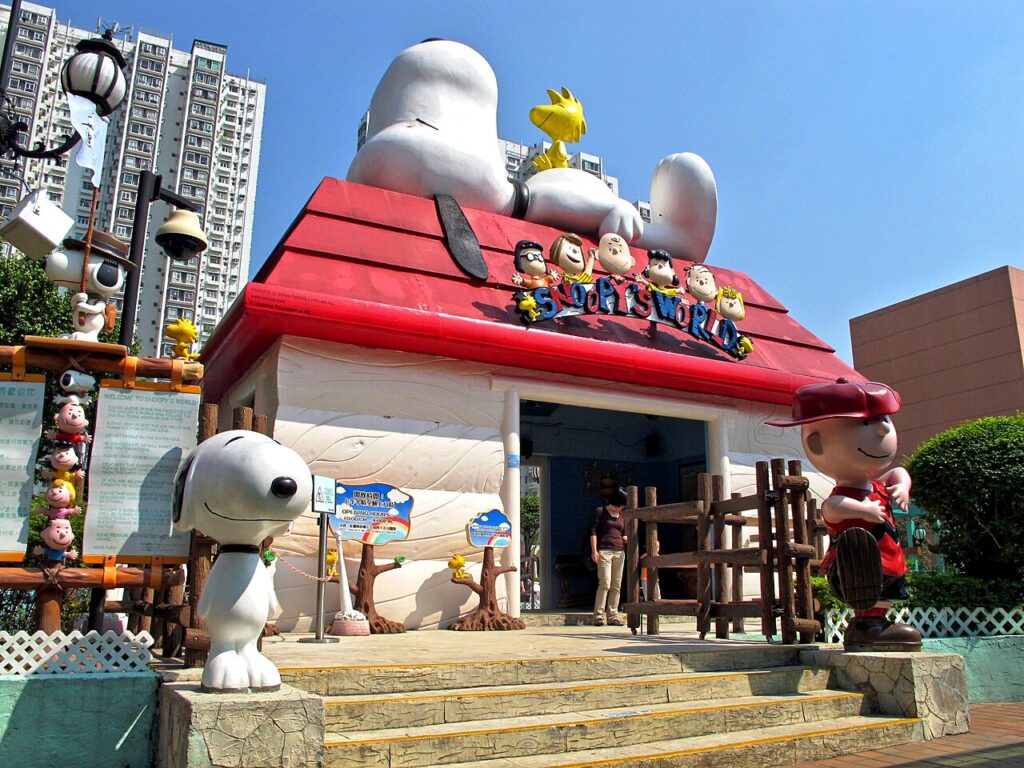
My view did not sweep across a grand, cinematic harbor of neon-lit junks, nor did it capture the misty, undulating peaks of the country parks. Instead, my window framed one of the most surreal and charming juxtapositions in the entire Special Administrative Region: a direct, bird’s-eye look down onto Snoopy’s World.
The Vertical City and the Horizontal Oases
To understand the magic and melancholy of that view, one must first understand the architectural theatre of Sha Tin. Outside my narrow horizon, the world surged upward in monolithic defiance. The landscape was defined by massive residential monoliths and commercial tower concrete giants stretching twenty, thirty, sometimes forty stories and beyond into the gray subtropical haze. These high-rises house hundreds of thousands of souls packed into apartments not much larger than mine, creating a hyper-dense ecosystem where privacy is traded for proximity.
In a city built entirely on vertical ambition, horizontal space is a radical luxury. Because the private apartments are so relentlessly small, Hong Kong’s residents master the art of the communal extension. The city’s parks, public squares, promenades, and rooftop podiums do not function merely as municipal amenities; they are the externalised living rooms, backyards, and social lungs of the populace.
From my high vantage point, I watched this daily choreography unfold. The crowded gardens and pocket parks scattered throughout the concrete canyons were never empty. They were intensely, vibrantly alive – used as an absolute necessity by families seeking relief from the atmospheric pressure of micro-apartments. Grandparents walking toddlers, teenagers huddled over phones beneath meagre patches of shade, and neighbours chatting in rhythmic bursts of Cantonese all bled out of their cramped domestic boxes to claim whatever square foot of open air they could find.
A Cartoon Dog Amid the Monoliths
And then, anchoring the middle ground right below my window, lay Snoopy’s World.
Opened in the late 1990s, this open-air, cartoon-themed amusement park perched on the third-floor podium of the New Town Plaza complex is a defiant splash of primary colours against a monochrome sea of grey concrete. It is entirely devoted to Charles Schulz’s world-weary beagle, his yellow-feathered sidekick Woodstock, and the gentle, nostalgic Americana of the Peanuts gang.
To a foreigner steeped in the cynical ironies of modern adulthood, the concept is inherently bizarre. Here you are, suspended in one of the most hyper-capitalist, densely populated, high-stakes metropolises on earth, looking down at a life-sized replica of Snoopy’s red doghouse resting atop a multi-story shopping mall, surrounded by towering steel-and-glass residential blocks.
Yet, as the days bled into weeks, I realised that the sheer absurdity of Snoopyland was precisely what made it sacred.
Whenever the claustrophobia of my apartment reached a crescendo – when the hum of the air conditioner felt like a physical weight and the walls seemed to hum with pressure – I would look down at the park. And almost instantly, the atmosphere of the room would shift, punctured by the most universal sound in human experience: the unbridled laughter of children.
The Soundtrack of Shared Joy
Snoopyland was never quiet, but its noise was entirely different from the harsh, metallic clatter of the MTR or the relentless drone of traffic grinding along Tai Po Road. It was a soundtrack composed of high-pitched giggles, the rhythmic splashing of the miniature canoe ride drifting through the artificial waterways, and the excited shouts of kids scampering around the playground structures.
The juxtaposition was staggering. Framing this whimsical, pint-sized sanctuary of cartoon dogs and plastic bone motifs were towering walls of residential high-rises, windows glowing like stacked matrices of grid-paper, housing thousands of lives squeezed into vertical micro-units. The children playing below belonged to those apartments. For them, the parks and the broader plaza podiums served as a vital decompression chamber.
Observing the crowds day after day, I saw a profound lesson in community resilience. Hong Kong can be an exhausting, relentlessly fast-paced place, especially for an outsider trying to decode its labyrinthine rhythms while managing the daily grind of teaching English to adults navigating their own linguistic and cultural transitions. It is a city that can easily make you feel isolated, trapped both physically within your four walls and culturally within your foreign skin.
Yet, looking down at Snoopyland dissolved that isolation. I would watch exhausted parents sitting on the bright yellow benches, nursing iced lemon teas while their children chased each other around a giant fiberglass Snoopy dressed as a World War I flying ace. I watched strangers share stroller space in the tight pathways, nodding to one another with tired, empathetic smiles.
There was a shared vulnerability in the crowd’s unspoken acknowledgment that we were all renting tiny slices of airspace in a city too big for any one person to fully master. But within the boundaries of that silly, cheerful cartoon theme park, scale didn’t matter. The crushing height of the surrounding towers vanished behind the simple, radiant geometry of a child’s smile.
Finding Room to Breathe
Living in that shoe-box apartment overlooking a cartoon dog taught me something vital about Hong Kong. It showed me that beauty and spaciousness are not always physical dimensions; sometimes, they are emotional states carved out of concrete and constraint.
My apartment remained tiny. The kitchen stayed cramped, the television screen close, and the bed ever-present. But the claustrophobia lost its grip on me. I learned to look past the immediate boundaries of my room, past the windowpane, down into the heart of the podium where a beagle in aviator goggles presided over a sea of laughing faces.
In a metropolis that constantly threatens to overwhelm you with its scale, Snoopyland was a reminder that joy doesn’t require vast acreage. Sometimes, it just needs a splash of red paint, a patch of open sky between towering monoliths, and a community willing to share every square inch of the world together.