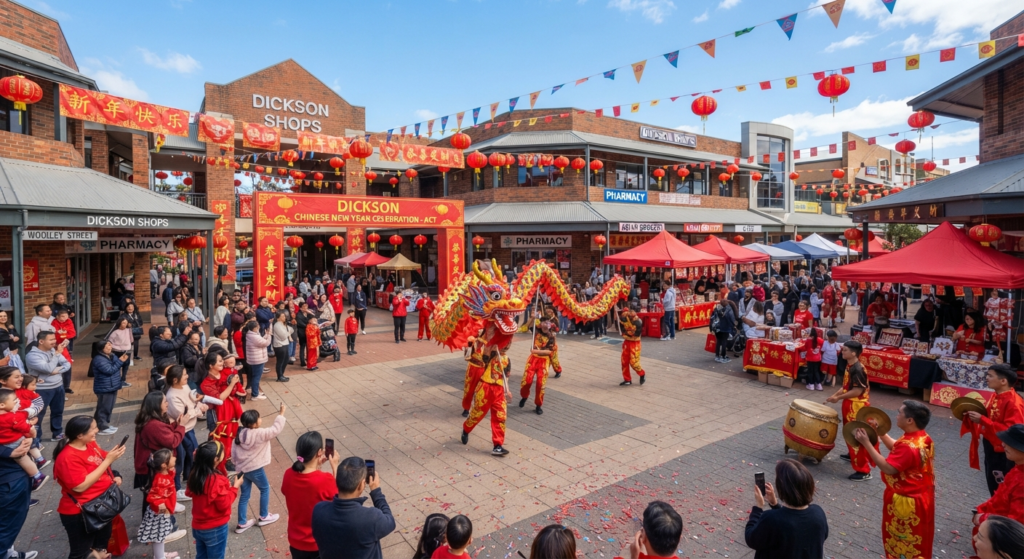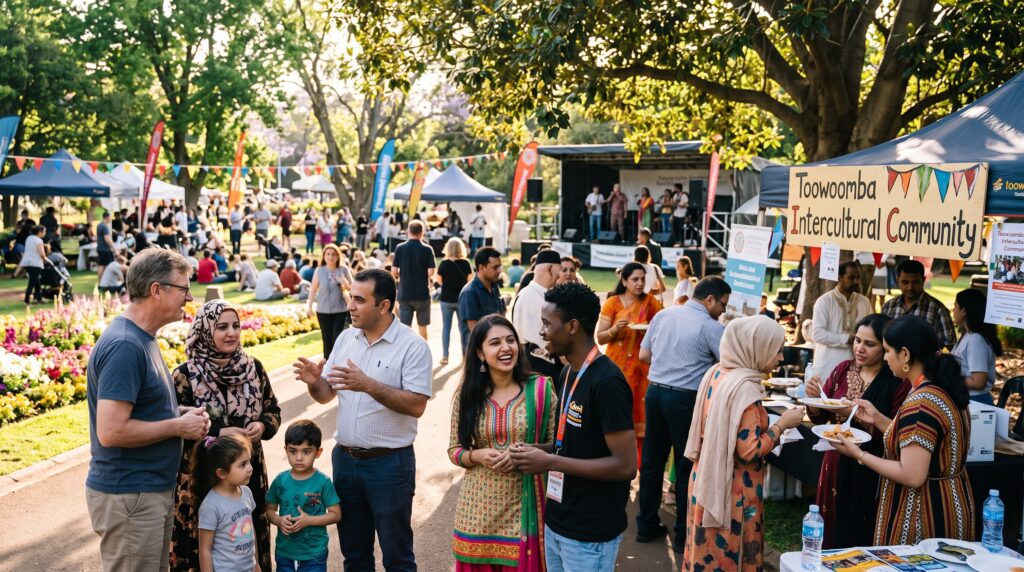
Step onto Ruthven Street on a Saturday morning, or wander through Queens Park during the annual International Street Fiesta, and you can hear the unmistakable cadence of a city in transformation. For more than a century, Toowoomba was defined in the national imagination by its temperate escarpment climate, its agricultural heritage on the Darling Downs, and its celebrated Carnival of Flowers. Yet beneath the canopy of jacarandas and camphor laurels, a quieter, far more profound cultivation has been taking place. Toowoomba has evolved from a traditional regional service centre into one of Australia’s most compelling examples of regional multicultural success.
Living in a multicultural city is often discussed in the abstract – framed through policy documents, economic white papers, or well-meaning platitudes about tolerance. In reality, cultural diversity is not a passive demographic footnote; it is an active, daily enrichment of civic, intellectual, and personal life. When different histories, languages, and worldviews converge in a regional city of manageable scale, the result is neither the fragmented anonymity of a sprawling metropolis nor the insular sameness of a monoculture. Instead, it creates a living laboratory of human connection.
Having spent decades working across classrooms, community advocacy networks, and broadcasting studios, I have had the privilege of witnessing this transformation from the inside out. Whether teaching adult English as an Additional Language (EAL) at TAFE Queensland, facilitating documentary projects with newly arrived youth, advocating for inclusive settlement pathways, or sitting behind a microphone at Toowoomba 102.7 FM and EMG World Radio, I have seen how a city grows larger in spirit when it opens its doors to the world.
By the Numbers: A Portrait of Diversity on the Darling Downs
To understand the depth of Toowoomba’s cultural evolution, one must first look at the demographic reality behind the anecdotes. According to Australian Bureau of Statistics (ABS) Census data and Toowoomba Regional Council’s demographic profiles, more than 14 per cent of the Toowoomba Region’s approximately 184,000 residents were born overseas, representing over 100 distinct nationalities. Alongside First Nations peoples who comprise roughly 5 per cent of the local government area’s population (nearly 8,700 individuals) and maintain the oldest living continuous cultures on Earth – the region’s ancestral tapestry stretches from its traditional Anglo-Celtic and nineteenth-century German foundations to every continent on the globe.
While early post-war migration brought waves of European settlers, the twenty-first century has reshaped Toowoomba’s linguistic and cultural landscape. In the 2021 Census, the top five countries of birth outside Australia were England, New Zealand, Iraq, India, and the Philippines. Crucially, the top five languages spoken at home other than English reveal the vibrant contemporary character of the city: Kurdish (specifically Kurmanji), Mandarin, Arabic, Nepali, and Punjabi.
Behind those figures lies a remarkable humanitarian story. Over the past decade, Toowoomba has earned formal recognition as both a Refugee Welcome Zone and an International City of Peace. Between 2016 and 2021 alone, the region welcomed more than 2,800 humanitarian entrants – at times surpassing Brisbane in annual regional humanitarian arrivals. Approximately 69 per cent of those recent humanitarian arrivals came from the Yazidi (Ezidi) community of northern Iraq and Syria, alongside significant cohorts of Iraqi, Syrian, Congolese, Afghan, and Sudanese families. Local settlement agencies estimate that secondary migration – families moving to Toowoomba from metropolitan centres in search of safety, affordability, and community cohesion – has brought the local Iraqi and Yazidi population alone to roughly 5,000 residents.
What makes these numbers extraordinary is not merely their scale, but the reception they have met. Research conducted by the University of Technology Sydney comparing refugee settlement in Brisbane, Logan, and Toowoomba found that 100 per cent of surveyed adult and youth humanitarian arrivals in Toowoomba reported feeling safe in their neighbourhoods, and 96 per cent described their neighbours as friendly. In 2025, Toowoomba Regional Council formalized this civic commitment by adopting Weaving a Collective Future: Toowoomba Region Intercultural Strategy 2025 – 2030, its first dedicated policy framework designed to move beyond passive coexistence toward active intercultural participation.
| Cultural & Demographic Indicator | Toowoomba Region Snapshot |
| Total Regional Population | ~184,377 residents |
| Overseas-Born Residents | >14% (representing 100+ nationalities) |
| First Nations Population | ~5.0% (8,677 residents) |
| Top Overseas Birthplaces | England, New Zealand, Iraq, India, Philippines |
| Top Non-English Languages | Kurdish, Mandarin, Arabic, Nepali, Punjabi |
| Humanitarian Settlement | >2,800 arrivals (2016 – 2021); ~5,000 estimated Iraqi/Yazidi residents via primary & secondary settlement |
The Classroom as a Crossroads of the World
Statistics map the contours of a community, but the classroom reveals its heartbeat. In my work as an adult EAL/ESL educator at TAFE Queensland, the morning roll call is a geography lesson in human resilience. Seated around the same tables are Yazidi mothers who survived displacement in Sinjar, engineers from Sudan, hospitality workers from the Philippines, nurses from Nepal, and tradespeople from Mainland China and Taiwan.
Teaching language in a multicultural regional city quickly disabuses an educator of any notion that learning is a one-way street. Yes, my primary responsibility is equipping adult learners with the English literacy, workplace communication, and digital media skills required to navigate Australian life and secure meaningful employment. Yet every lesson is an exchange of epistemologies – different ways of organizing thought, expressing respect, and solving problems.
When a class discusses something as seemingly straightforward as “community” or “family obligation,” the room expands. A student from Eritrea explains the communal childcare networks of her village; a classmate from Punjab describes the agricultural rhythms of northern India; a young man from Iraq recounts how poetry is memorized and recited in family gatherings as a living archive of history. For an educator with a background in both TESOL and international aviation communication, the parallels are striking: just as safe international aviation depends on standardized clarity paired with deep cross-cultural awareness, a thriving multicultural city depends on a shared civic language that honours, rather than erases, the accents and histories of its speakers.
Perhaps nowhere is this creative synergy more visible than when working with younger generations. Facilitating an eighteen-week youth documentary video project with multicultural students at TAFE Queensland demonstrated what happens when young people are handed cameras, microphones, and editing suites and invited to tell their own stories. Initially hesitant, students who had navigated the dislocation of migration began framing their adopted city through their own lenses – filming local parks, interviewing elders, and capturing the quiet dignity of parents starting over in a new tongue. They were not merely learning digital media production; they were claiming authorship over Toowoomba’s contemporary narrative.
The Economic and Civic Engine of Regional Diversity
Beyond the moral and interpersonal rewards of inclusion lies a pragmatic truth that regional Australia increasingly recognizes: multiculturalism is an indispensable economic and demographic engine. Like many regional centres, Toowoomba faces an ageing workforce and persistent skills shortages across healthcare, agriculture, construction, manufacturing, and hospitality. Migration does not strain a regional economy; it sustains it.
Walk through the wards of Toowoomba Hospital or St Vincent’s, and you will find doctors, registered nurses, and aged-care specialists from India, the Philippines, Zimbabwe, and the United Kingdom keeping essential services running around the clock. Drive out toward the Lockyer Valley or across the Darling Downs, and you will see agricultural enterprises and food-processing facilities powered by migrant workers whose labour underpins Queensland’s food security.
Equally transformative is the entrepreneurial energy that newcomers bring to local high streets. Multicultural cities benefit from what economists call “diversity dividends” new business formation, international trade linkages, and culinary and retail revitalization. In Toowoomba, vacant shopfronts have been reborn as Middle Eastern bakeries, Nepali grocers, Indian spice markets, Filipino cafes, and African hair salons. These enterprises do far more than diversify local dining options; they create entry-level employment for family members, circulate capital locally, and turn commercial precincts into social gathering spaces.
Advocacy and the Work of Genuine Belonging
Celebrating multiculturalism should never mean ignoring its friction points. True advocacy requires honesty about the barriers newcomers face – and a willingness to dismantle them systematically. In Toowoomba, as across regional Australia, humanitarian entrants and skilled migrants alike encounter hurdles: non-recognition of overseas qualifications, transport limitations in a car-dependent regional city, trauma recovery, and the subtle hesitation of employers who equate a non-Australian accent with reduced capability.
Real enrichment occurs when established residents step beyond passive goodwill into active solidarity. Throughout my involvement in community advocacy – connecting with local settlement providers, participating in civic forums such as the Welcoming Australia Summit, and mentoring emerging writers and creators, one lesson stands out: hospitality is welcoming someone into your house; inclusion is handing them a key and rearranging the furniture together.
In Toowoomba, that collaborative spirit is visible in the dense network of grassroots partnerships between Toowoomba Regional Council’s Multicultural Advisory Committee, Multicultural Australia, CatholicCare Social Services, Mercy Community, local schools, and sporting clubs. When local employers partner with TAFE Queensland to create supported work-experience pathways, or when community volunteers help newly arrived adults prepare for their Queensland driver’s licence tests, abstract policy becomes tangible social capital.
This advocacy also extends into the arts and literature. Mentoring Melbourne-based poet and writer Reza Gharib on The Salt Line a collaborative poetry collection and serialized audio podcast, and exploring the long literary lineage of diaspora writing from Ameen Rihani to contemporary Australian voices have reinforced for me how vital storytelling is to civic health. When migrant and refugee artists publish books, record podcasts, and see their works lodged in national archives, they shift from being subjects of charitable concern to recognized architects of Australian culture.
Amplifying Many Voices: Community Broadcasting as Civic Glue
If the classroom builds individual confidence and advocacy reshapes institutions, community broadcasting weaves those threads into the shared public square. In an era of algorithmic media bubbles where residents living on the same street can inhabit entirely separate informational worlds – local radio remains one of the few democratic mediums capable of bringing an entire city into the same room.
Presenting a weekly Thursday evening music program on terrestrial community station Toowoomba 102.7 FM, alongside launching and hosting Global Tapestry – weekly cultural interview program and podcast broadcast on 102.7 FM and EMG World Radio – has given me a front-row seat to the unifying power of voice and music.
Music bypasses intellectual defensiveness faster than almost any other art form. On a Thursday night, a broadcast might move seamlessly from classic progressive rock to Turkish psychedelic folk-rock by Altın Gün, the haunting Sufi-inflected vocals of Pakistani-born composer Arooj Aftab, or traditional Norwegian folk songs. Listeners tune in expecting familiar comfort and discover an unexpected kinship with sounds from halfway across the globe. Curiosity replaces apprehension.
On Global Tapestry, the medium becomes explicitly conversational. Over forty-five to fifty minutes each week, the program sits down with educators, community leaders, artists, migrants, and long-time locals to explore the lived realities behind Toowoomba’s cultural mosaic. Hearing a newly arrived resident speak in their own voice, sharing the humour of adjusting to Australian slang, the grief of leaving behind a homeland, and the pride of watching their children graduate from a Toowoomba high school humanizes statistics in a way no newspaper editorial ever could. For listeners from culturally and linguistically diverse backgrounds, hearing their own communities represented with dignity on local airwaves sends an unmistakable message: You belong here, and your story matters to this city.
Cognitive and Cultural Expansion for Every Resident
A common misconception is that multiculturalism primarily benefits newcomers. In truth, the greatest beneficiaries of a diverse city are often the long-term residents whose horizons are widened without ever needing to board an international flight.
Living alongside neighbours from over a hundred nations cultivates what psychologists call cognitive flexibility – the capacity to hold multiple perspectives simultaneously, tolerate ambiguity, and question unexamined assumptions. Children growing up in Toowoomba schools today learn alongside classmates who speak Kurdish, Mandarin, Dinka, Tagalog, or Nepali at home. They celebrate Harmony Week, share lunches that introduce them to unfamiliar spices, and develop an intuitive fluency in navigating cultural difference. In an interconnected twenty-first-century economy, that intercultural competence is not merely a social grace; it is a decisive life advantage.
Even at a personal, everyday level, multicultural living enriches the texture of neighbourhood life. In my own suburb of Harristown, walking down the street means exchanging greetings with families whose life journeys span continents. It reshapes how we view everything from gardening and food to hospitality and resilience. When you share fence lines with people who have rebuilt their lives from scratch after war or displacement, petty daily inconveniences shrink to their proper proportions. Gratitude becomes contagious.
The Future of the Garden City
Toowoomba’s journey is neither finished nor free of challenges. Rapid population growth, housing affordability pressures, and the ongoing need for coordinated settlement funding require sustained political will and community vigilance. Yet the foundation laid over the past two decades offers a blueprint for regional cities across Australia and beyond.
The secret to Toowoomba’s success lies in scale and intentionality. Large enough to sustain specialized health, educational, and settlement infrastructure anchored by institutions like the University of Southern Queensland and TAFE Queensland yet intimate enough that a local councillor, a TAFE teacher, a community radio host, and a newly arrived family can meet at the same Saturday market, Toowoomba proves that regional communities do not have to choose between preserving their heritage and embracing the future.
In horticulture, monocultures are fragile; a single blight can devastate an entire crop. Biodiversity, by contrast, builds resilience, enriches the soil, and yields a far more abundant harvest. Cities work the same way. By welcoming over a hundred nationalities to the Darling Downs, Toowoomba has not lost its identity as the Garden City – it has finally discovered what its soil was meant to grow.