There is a precise moment during your first trip to East and Southeast Asia when everything you thought you understood about urban transit quietly evaporates. For anyone raised on Western roads where white paint dictates spatial boundaries, traffic signals function as non-negotiable law, and road rage explodes over minor infractions standing on a curb in Taipei or Ho Chi Minh City feels less like watching traffic and more like observing a fluid physical phenomenon.
It is a world defined not by lanes, right-of-way, or rigid protocol, but by momentum, anticipation, and an extraordinary, collective patience. Across the dense urban corridors of East and Southeast Asia, the scooter is not merely a mode of transportation; it is the beating heart of the metropolis.
1. Taipei: The River of Engine Hum
Stepping out of the air-conditioned sanctuary of Taipei Main Station into the humid air, the first thing that hits you isn’t the heat or the aroma of night markets it is the hum. It begins as a low, collective purr, building to a high-pitched buzz whenever the lights change along Zhongxiao East Road.
In Taiwan, scooters are ubiquitous. With millions registered across the island, Taipei during rush hour offers a masterclass in urban density. Watching from a pedestrian overpass, the traffic does not move like a series of individual cars queuing neatly in lanes. Instead, it moves as a single, unbroken river of bikes flowing through the streets.
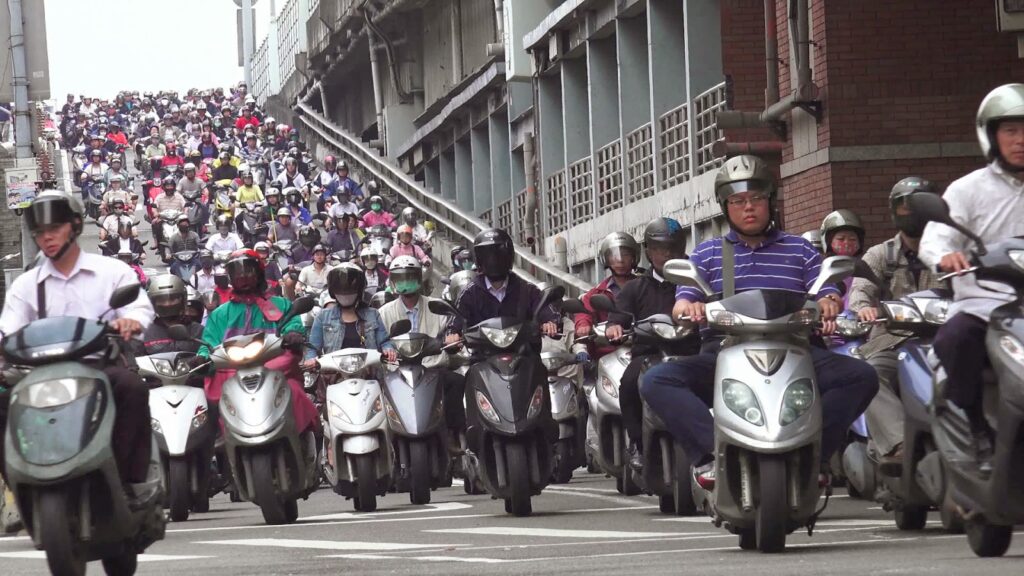
When a red light stops the flow, hundreds of scooters filter effortlessly between idling sedans and buses, pooling at the front in designated two-wheeler box zones. The moment the light turns green, the pool bursts forward in a sudden cascade.
The famous “scooter waterfall” at Taipei Bridge – where thousands of commuters pour down a ramp every morning – is perhaps the purest visual expression of this dynamic. To a Westerner conditioned to expect road rage or territorial driving, the startling realization is how smoothly this vast tide operates. There are no raised fists, no aggressive honking matches, and no posturing. Riders move shoulder-to-shoulder, inches apart, maintaining a shared spatial awareness that feels almost telepathic.
2. Hsinchu: The Winds of the Tech Capital
Further south along Taiwan’s western coast sits Hsinchu, widely known as the island’ s Silicon Valley. Here, high-tech science parks sit alongside bustling traditional neighborhoods, creating a unique urban rhythm. Hsinchu is famous for its fierce coastal winds, but its traffic is defined by an equally relentless force: thousands of engineers, students, and families navigating narrow alleyways on two wheels.
In Hsinchu, the lack of reliance on strict lane discipline becomes even more obvious. Street markings exist on paper, but on the asphalt, they serve merely as faint suggestions.
“Where a Western driver sees two distinct lanes divided by a painted line, a local rider sees a dynamic spectrum of space capable of fitting three scooters, a delivery trike, and a turning SUV all at once.”
Here, traffic flows around obstacles much like water around rocks in a stream. If a delivery truck stops in the middle of a lane, there is no screeching of brakes or outburst of frustration. The stream simply widens, bending effortlessly into oncoming territory before sweeping back into place. Riders in Hsinchu demonstrate a remarkable resilience to environmental chaos—navigating crosswinds, narrow historic lanes, and tight turns with a steady hand and calm demeanor.
3. Ho Chi Minh City: The Whirlpool of Saigon
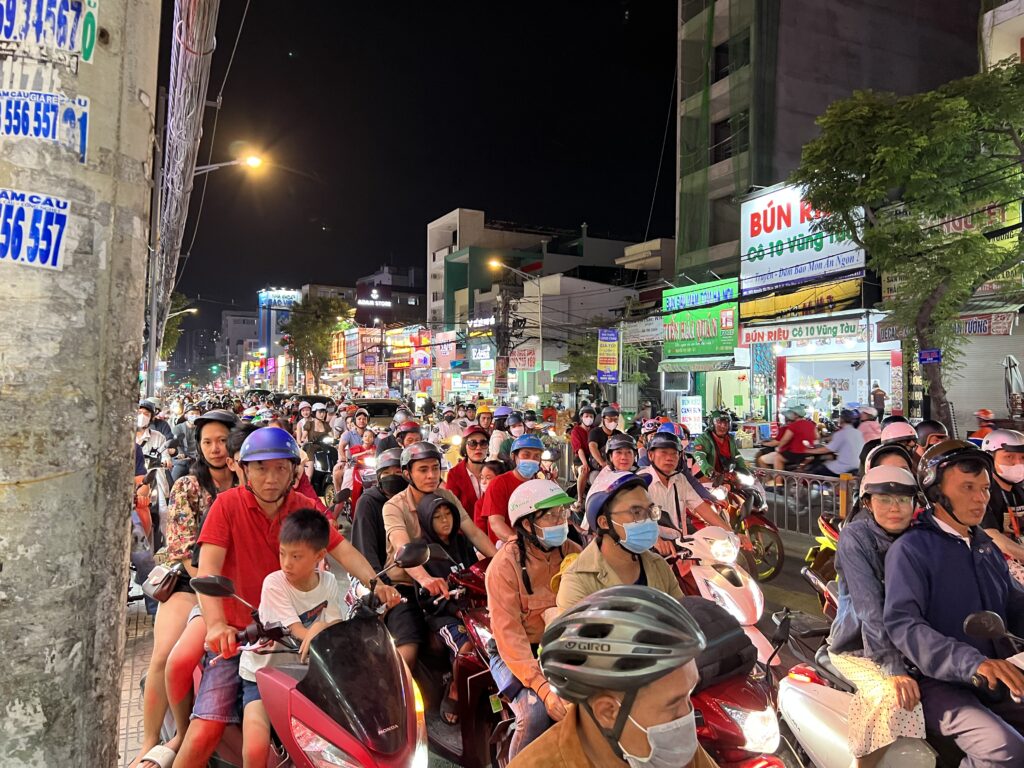
If Taipei is a regulated river and Hsinchu a brisk stream, Ho Chi Minh City (Saigon) is an oceanic storm. Nothing quite prepares a traveler for the raw, kinetic energy of Vietnam’s largest city.
Crossing the street in Ho Chi Minh City is famously described to tourists as an act of faith: walk at a steady, predictable pace, do not make sudden movements, and let the traffic flow around you.
In Saigon, the sheer volume of scooters is staggering. Entire families, parents, children, and pet dogs all balance on a single 110cc Honda Wave. Goods that would normally require a pickup truck in the West are routinely strapped to the back of a scooter: stacks of plastic chairs, full-sized refrigerators, or crates of tropical fruit.
The true pinnacle of this experience occurs at the city’s major roundabouts, such as the one near Ben Thanh Market. To an outsider looking on from a sidewalk cafe, these intersections look like a terrifying kinetic vortex. Roundabouts function like a giant, swirling whirlpool, drawing thousands of vehicles into a central vortex where right-of-way simply does not exist.
Scooters enter from every direction, crossing paths at acute angles, weaving through buses, and merging without a single driver stopping. Yet, despite the apparent madness, collision is exceptionally rare. Drivers read each other’s trajectories, using soft taps of the horn not as an insult, but as an polite acoustic beacon: “I am here, passing on your left.”
4. Understanding “Organized Chaos”
The term most frequently used by travelers trying to decipher this experience is organised chaos. At first, the phrase sounds like an oxymoron. How can chaos be organized?
The secret lies in the underlying philosophy of the road. In many Western countries, road safety relies heavily on top-down enforcement:
- Rigid legal structures
- Strict adherence to right-of-way
- High speed limits combined with minimal tolerance for rule-breaking
In contrast, driving culture in cities like Ho Chi Minh City, Taipei, and Hsinchu relies on bottom-up adaptability:
| Cultural Dimension | Western Driving Culture | East/Southeast Asian Scooter Culture |
| Primary Metric | Speed & Strict Right-of-Way | Flow & Continuous Adaptation |
| Spatial Awareness | Personal Bubble / Lane Discipline | Micro-Space Utilization |
| Communication | Turn Signals & Horn as Aggression | Gentle Horn Taps as Spatial Beacons |
| Conflict Resolution | Asserting Right-of-Way | Yielding to Immediate Motion |
Riders do not demand that the environment conform to rules; they continuously adjust themselves to the immediate reality around them. If a scooter suddenly pulls out from a side street without looking, the main line of traffic does not slam on brakes in anger – it simply sways outward, absorbing the entry like a wave accommodating a drop of water.
5. The Grace Within the Storm
As a Western observer, spending weeks watching this daily miracle shifts your perspective from terror to deep admiration.
What looks like reckless driving from a distance is revealed, upon closer inspection, to be an exercise in extraordinary focus, patience, and collective trust. There is a profound empathy built into this shared movement. Riders constantly look out for one another, anticipating moves before they happen, forgiving minor encroachments instantly, and moving forward with a calm, unbothered rhythm.
In an era where Western roads are increasingly defined by isolation, road rage, and frustration, the scooter-filled streets of Taipei, Hsinchu, and Ho Chi Minh City offer a fascinating lesson. Within what appears to be pure mayhem lies a remarkably resilient social ecosystem – a testament to human adaptability and the quiet beauty of moving together as one.