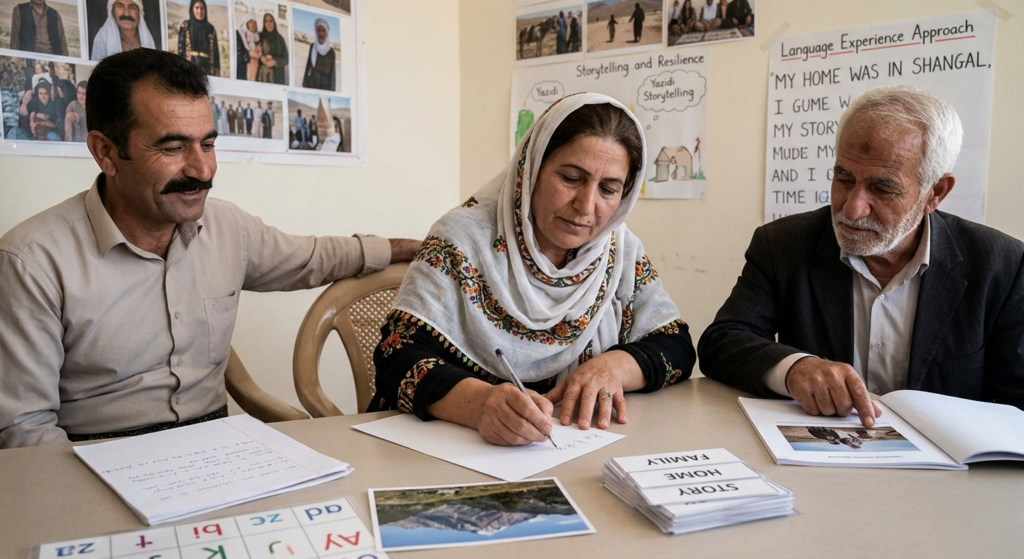
Teaching English as a Second Language (ESL) to adult learners who possess low or no literacy skills—often referred to as LESLLA (Literacy Education and Second Language Learning for Adults) learners—presents a unique and profound pedagogical challenge. In my own work, particularly when supporting adult Yazidi students, I have witnessed firsthand that this is not merely an instructional task, but an act of deep cultural and human mediation. These learners do not just face the difficulty of acquiring a new language; they must often navigate the dual hurdle of mastering the mechanics of reading and writing while processing the profound impact of displacement and trauma.
The Cognitive Dimension: The “Double Load”
The most significant hurdle is the simultaneous acquisition of literacy and language. For a literate adult, reading is a decoding process; they map known sounds to unfamiliar written symbols. For my Yazidi students, many of whom have had their formal education interrupted by conflict, this process is compounded. They must first develop phonemic awareness—the ability to identify and manipulate individual sounds—which is a significant shift for someone who has not previously interacted with a written script in their primary language.
The brain processes information differently when literacy is not yet established. The abstract nature of a written page—a condensed, symbolic representation of reality—can feel alien. When I teach English vocabulary to these students, I am not just teaching new words; I am teaching the concept that a series of marks on a page holds static, consistent meaning. If a learner has not developed that foundational belief in the permanence of the written word, the introduction of English syntax becomes overwhelmingly abstract.
The Affective Dimension: Empathy and Resilience
The classroom environment for adult learners with limited prior schooling is often fraught with anxiety, shame, and frustration. In my experience with Yazidi students, the classroom must function as a sanctuary. Many have experienced significant life trauma, and their presence in the classroom is an act of immense bravery.
This requires a delicate balance of maintaining the dignity of the adult learner while using materials that are, by necessity, foundational. I have found that being treated like a child in an educational setting is deeply demoralizing for an adult who has already navigated complex life challenges. My goal is always to validate their existing life wisdom—their resilience, their history, and their community roles—while fostering academic growth. When I see a student who has lived through such adversity take the first step toward writing their name in English, it is a testament to their strength, not just their capacity to learn a new linguistic code.
Structural and Methodological Challenges
The traditional ESL curriculum, which relies heavily on pre-packaged textbooks, is often entirely unsuitable for this demographic. I have had to move away from rigid structures, opting instead for a “Learner-Centered Approach.” I often use the Language Experience Approach, where the student’s own stories—stories of their home, their culture, or their journey—become the primary reading material.
For non-literate learners, abstract grammar rules are meaningless. Literacy must be taught through functional, real-world tasks—such as reading a map of the local area, identifying essential labels, or understanding medical documents. By grounding literacy in their immediate, tangible needs, I can transform the “daunting” act of learning into a tool for self-sufficiency and empowerment.
Systemic Limitations and the Path Forward
Systemically, we face significant hurdles. Many adult education programs operate under pressure to meet standardized benchmarks, which often fail to account for the slow, non-linear progress of LESLLA learners. If we force students to “mimic” literacy—recognizing words by shape rather than decoding them—we do them a disservice. We must protect the time it takes to build foundational skills, even when it feels like progress is slow.
Conclusion
Teaching English to non-literate adult students, particularly those from marginalized or displaced communities like the Yazidi people, requires a commitment to a holistic, trauma-informed, and highly contextualized pedagogy. It demands that we treat literacy not as a prerequisite for participation in society, but as a fundamental human right. My experience has taught me that when we move beyond traditional linguistic methodologies and genuinely listen to the stories our students carry, we create an environment where they can transition from the margins of society to active, confident, and literate participation. The journey is complex and, at times, difficult, but seeing an adult learner gain the agency to communicate their own voice is, without question, one of the most rewarding outcomes in the field of education.
Given your specialized experience, would you like to refine the “Language Experience Approach” section to include a specific activity or technique you’ve found successful with your Yazidi students?